Urban, Rural, or In-Between?
An adapted Territorial Typology for NUTS 2 regions
DOI:
https://doi.org/10.18335/region.v13i2.641Abstract
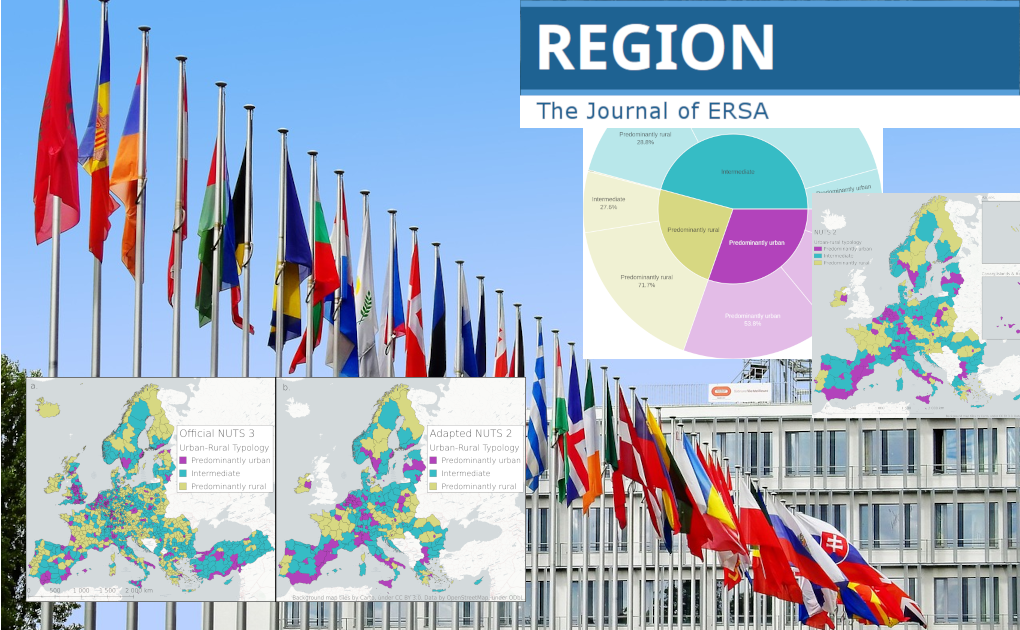
We describe the adapted urban-rural typology at the NUTS 2 regional level, an extension of the official regional urban-rural typology provided by the European Union at the NUTS 3 regional level. We used the Census Grid 2021 data and urban agglomerations data to construct an adapted typology. A typology at the NUTS 2 level enables more opportunities for regional analyses and policymaking, as European regional statistics are primarily provided at this level. The EU's regional policies, such as its Cohesion Policy, are implemented at the NUTS 2 level, and for many countries NUTS 2 levels represent administrative regions with substantial administrative, legislative, and fiscal powers. In this resource description article, we describe our adapted urban-rural typology at the NUTS 2 level and how we produced the dataset using the Census Grid 2021, Joint Research Centre's Urban Agglomerations data, and the NUTS 2 regional polygons provided by Eurostat, the European Union statistical authority. We provide the adapted urban-rural typology layer at the NUTS 2 regional level and the typology production scripts openly to support regional analyses and policymaking in Europe.
References
Alexander Wandl DI, Nadin V, Zonneveld W, Rooij R (2014) Beyond urban--rural classifications: Characterising and mapping territories-in-between across Europe. Landscape and Urban Planning 130: 50--63. https://doi.org/10.1016/j.landurbplan.2014.06.010
Ballas D, Kalogeresis T, Labrianidis L (2003) A comparative study of typologies for rural areas in Europe. 43rd Congress of the European Regional Science Association, Jyv"askyl"a, Finland. Available at https://hdl.handle.net/10419/116230
Blunden JR, Pryce WTR, Dreyer P (1998) The classification of rural areas in the European context: An exploration of a typology using neural network applications. Regional Studies 32: 149--160. https://doi.org/10.1080/00343409850123035
Bondarenko M, Priyatikanto R, Tejedor Garavito N, Zhang W, McKeen T, Cunningham A, Woods T, Hilton J, Cihan D, Nosatiuk B, Brinkhoff T, Tatem A, Sorichetta A (2025) Constrained estimates of 2015-2030 total number of people per grid square at a resolution of 30 Arc (approximately 1km at the Equator) R2025A version V1. Web page, University of Southampton. https://doi.org/10.5258/SOTON/WP00840
Bondarenko M, Zhang W, Tejedor Garavito N, Nosatiuk B, Tatem A, Sorichetta A (2025) Degree of urbanisation classes using WorldPop Global2 R2025A population data with the GHSL GHS-DUG tool. Web page, University of Southampton. https://doi.org/10.5258/SOTON/WP00879
Brandmueller T, Sch"afer G, Ekkehard P, M"uller O, Angelova-Tosheva V (2017) Territorial indicators for policy purposes: NUTS regions and beyond. Regional Statistics 7: 78--89. https://doi.org/10.15196/RS07105
Brezzi M, Dijkstra L, Ruiz V (2011) OECD extended regional typology: The economic performance of remote rural regions. OECD Regional Development Working Papers, 2011/06. https://doi.org/10.1787/5kg6z83tw7f4-en
Chamberlain HR, Dooley CA, Kakungu F, Tatem AJ (2026) Assessing the accuracy of census-independent small area modelled population datasets. Preprint on Research Square. https://doi.org/10.21203/rs.3.rs-9558335/v1
Cotella G, Rivolin UJ, Pede E, Pioletti M (2021) Multi-level regional development governance: A European typology. European Spatial Research and Policy 28: 201--221. https://doi.org/10.18778/1231-1952.28.1.11
de Beer J (2014) New classification of urban and rural NUTS 2 regions in Europe. NiDi working paper, 2014/3, Netherlands Interdisciplinary Demographic Institut. Available at https://www.nidi.nl/shared/content/output/papers/nidi-wp-2014-03.pdf
DG Regional and Urban Policy -- Directorate-General for EU Regional and Urban Policy (2026) Webinar on urban agglomerations: Presenting a new prototype -- regional and urban policy. Webinar. https://regions-and-cities.ec.europa.eu/cities-portal/events-cities/urban-agglomerations-presenting-new-prototype-2026-02-27_en
Dijkstra L, Florczyk AJ, Freire S, Kemper T, Melchiorri M, Pesaresi M, Schiavina M (2021) Applying the degree of urbanisation to the globe: A new harmonised definition reveals a different picture of global urbanisation. Journal of Urban Economics 125. https://doi.org/10.1016/j.jue.2020.103312
European Commission: Eurostat (2021) Applying the Degree of Urbanisation: A Methodological Manual to Define Cities, Towns and Rural Areas for International Comparisons : 2021 Edition. Publications Office of the European Union, Luxembourg. https://doi.org/10.2785/706535
European Commission: Eurostat (2024) Regions in the European Union Nomenclature of Territorial Units for Statistics (NUTS)/ (2024 ed.). Publications Office of the European Union, Luxembourg, Luxembourg. https://doi.org/10.2785/714519
Eurostat (2024) Cohesion policy indicators. Technical report. Available at https://ec.europa.eu/eurostat/statistics-explained/SEPDF/cache/130610.pdf, Eurostat, Luxembourg
Eurostat (2025a) Census grid 2021. Web page, Available at https://ec.europa.eu/eurostat/web/gisco/geodata/population-distribution/population-grids
Eurostat (2025b) NUTS - Nomenclature of territorial units for statistics. Web page. Available at https://ec.europa.eu/eurostat/web/nuts/overview
Eurostat (2025) Territorial typologies manual - urban-rural typology. Web page. Available at https://ec.europa.eu/eurostat/statistics-explained/index.php?title=Territorial_typologies_manual_-_urban-rural_typology
Fertner C (2012) Downscaling European urban-rural typologies. Geografisk Tidsskrift-Danish Journal of Geography 112: 77--83. https://doi.org/10.1080/00167223.2012.707805
Fiaschetti M, Marcello G, and Heumann BW (2021) A data-based approach to identifying regional typologies and exemplars across the urban--rural gradient in Europe using affinity propagation. Regional Studies 55: 1939--1954. https://doi.org/10.1080/00343404.2021.1871598
Hedlund M (2016) Mapping the socioeconomic landscape of rural Sweden: Towards a typology of rural areas. Regional Studies 50: 460--474. https://doi.org/10.1080/00343404.2014.924618
Herbst M, Pechci'nska A, Hagemejer J, Artymowska P (2025) Spa(tia) -- a diffusion-oriented method of territorial impact assessment. Impact Assessment and Project Appraisal 43: 111--122. https://doi.org/10.1080/14615517.2024.2321547
L'ang-Ritter J, Keskinen M, Tenkanen H (2025) Global gridded population datasets systematically underrepresent rural population. Nature Communications 16: 12. https://doi.org/10.1038/s41467-025-56906-7
Lipshitz G (1986) A spatial typology of Israel on the basis of partial-order analysis. Geographical Analysis 18: 324--342. https://doi.org/10.1111/j.1538-4632.1986.tb00105.x
Malekzadeh M, V"ais"anen T, Panori A, Royuela V, J"arv O (2026) How regional characteristics drive various human mobility types across Europe. Nature Communications 17: 1--15. https://doi.org/10.1038/s41467-026-73288-6
Mart'inez-Reyes A, Lieu J, de Vries G, Hoppe T (2025) Introducing a typology of energy regions: A systematic literature review. Renewable and Sustainable Energy Reviews 207: 114961. https://doi.org/10.1016/j.rser.2024.114961
Newsham N, Rowe F (2023) Understanding trajectories of population decline across rural and urban Europe: A sequence analysis. Population, Space and Place 29: e2630. https://doi.org/10.1002/psp.2630
Pinto-Correia T, Guiomar N, Guerra CA, Carvalho-Ribeiro S (2016) Assessing the ability of rural areas to fulfil multiple societal demands. Land Use Policy 53: 86--96. https://doi.org/10.1016/j.landusepol.2015.01.031
Royuela V, Panori A, L'opez-Tamayo J (2026) The role of regional readiness for green and digital transitions in shaping attractiveness: A composite index approach. The Annals of Regional Science 75: 54. https://doi.org/10.1007/s00168-026-01493-8
Schiavina M, Melchiorri M, Freire S (2023) GHS-DUC R2023A - GHS degree of urbanisation classification, application of the degree of urbanisation methodology (Stage II) to GADM 4.1 layer, multitemporal (1975-2030). Dataset.newblock https://doi.org/10.0.11.89/DC0EB21D-472C-4F5A-8846-823C50836305
Schiavina M, Van Migerode C, Melchiorri M, Pesaresi M, Dijkstra L (2026) An Urban Agglomerations Prototype Using the Degree of Urbanisation. Publications Office of the European Union, Luxembourg, Luxembourg. https://doi.org/10.2760/3366043
Stjernberg M, Vasilevskaya A, Penje O (2024) Towards a grid-based Nordic territorial typology : A new tool for analysis across the urban-rural continuum. Report, Nordregio. https://doi.org/10.6027/R2024:91403-2503
Thomson DR, Mahmoud H, Stevens FR, Chen R, Kavvada A, Tatem A, Gros A, Gaughan AE (2025) Assessment of gridded population data in slums for SDG11 monitoring using community generated data. Preprint on Research Square. https://doi.org/10.21203/rs.3.rs-7160039/v1
United Nations (2019) World Urbanization Prospects: The 2018 Revision. ST/-ESA/-SER.A/420. United Nations, New York.newblock https://population.un.org/wup/assets/WUP2018-Report.pdf
V"ais"anen T, Havusela MK, Malekzadeh M, J"arv O (2026) An adapted urban-rural territorial typology for NUTS 2 regions. Spatial dataset. zenodo, CERN, Geneva, Switzerland. https://doi.org/10.5281/zenodo.22658053
V"ais"anen T, Malekzadeh M, Havusela M, Inker"oinen O, J"arv O (2024) Complete Mobi-Twin Dataset. Technical report. zenodo, CERN, Geneva, Switzerland. https://doi.org/10.5281/zenodo.14228376
Van Eupen M, Metzger M, P'erez-Soba M, Verburg P, Van Doorn A, Bunce R (2012) A rural typology for strategic European policies. Land Use Policy 29: 473--482. https://doi.org/10.1016/j.landusepol.2011.07.007
Velthuis S, Royer J, Le Petit-Guerin M, Cauchi-Duval N, Franklin R, Leibert T, MacKinnon D, Pike A (2025) Regional varieties of `left-behindness' in the EU15. Regional Studies 59: 1--16. https://doi.org/10.1080/00343404.2024.2417704
Zdrav zil P, Kraftov'a I (2023) Territorial revisions to increase cohesion policy funding from the EU: The case of the new member states. Baltic Journal of Economics 23: 142--161. https://doi.org/10.1080/1406099X.2023.2259249
Zhang WB, Woods D, Olowe ID, Schiavina M, Fang W, Hornby G, Bondarenko M, Maes J, Dijkstra L, Tatem AJ, Sorichetta A (2025) Assessing the impacts of gridded population model choice on degree of urbanisation metrics. Cities 166: 106293. https://doi.org/10.1016/j.cities.2025.106293
Downloads
Published
How to Cite
Issue
Section



License
Copyright (c) 2026 Tuomas Väisänen, Maija Havusela, Milad Malekzadeh, Olle Järv

This work is licensed under a Creative Commons Attribution 4.0 International License.
REGION is an open journal, and uses the standard Creative Commons license: Copyright We want authors to retain the maximum control over their work consistent with the first goal. For this reason, authors who publish in REGION will release their articles under the Creative Commons Attribution license. This license allows anyone to copy and distribute the article provided that appropriate attribution is given to REGION and the authors. For details of the rights authors grant users of their work, see the "human-readable summary" of the license, with a link to the full license. (Note that "you" refers to a user, not an author, in the summary.) Upon submission, the authors agree that the following three items are true: 1) The manuscript named above: a) represents valid work and neither it nor any other that I have written with substantially similar content has been published before in any form except as a preprint, b) is not concurrently submitted to another publication, and c) does not infringe anyone’s copyright. The Author(s) holds ERSA, WU, REGION, and the Editors of REGION harmless against all copyright claims. d) I have, or a coauthor has, had sufficient access to the data to verify the manuscript’s scientific integrity. 2) If asked, I will provide or fully cooperate in providing the data on which the manuscript is based so the editors or their assignees can examine it (where possible) 3) For papers with more than one author, I as the submitter have the permission of the coauthors to submit this work, and all authors agree that the corresponding author will be the main correspondent with the editorial office, and review the edited manuscript and proof. If there is only one author, I will be the corresponding author and agree to handle these responsibilities.